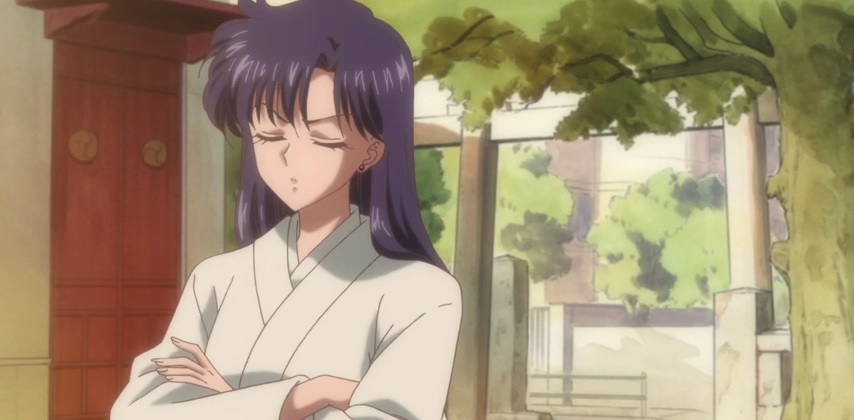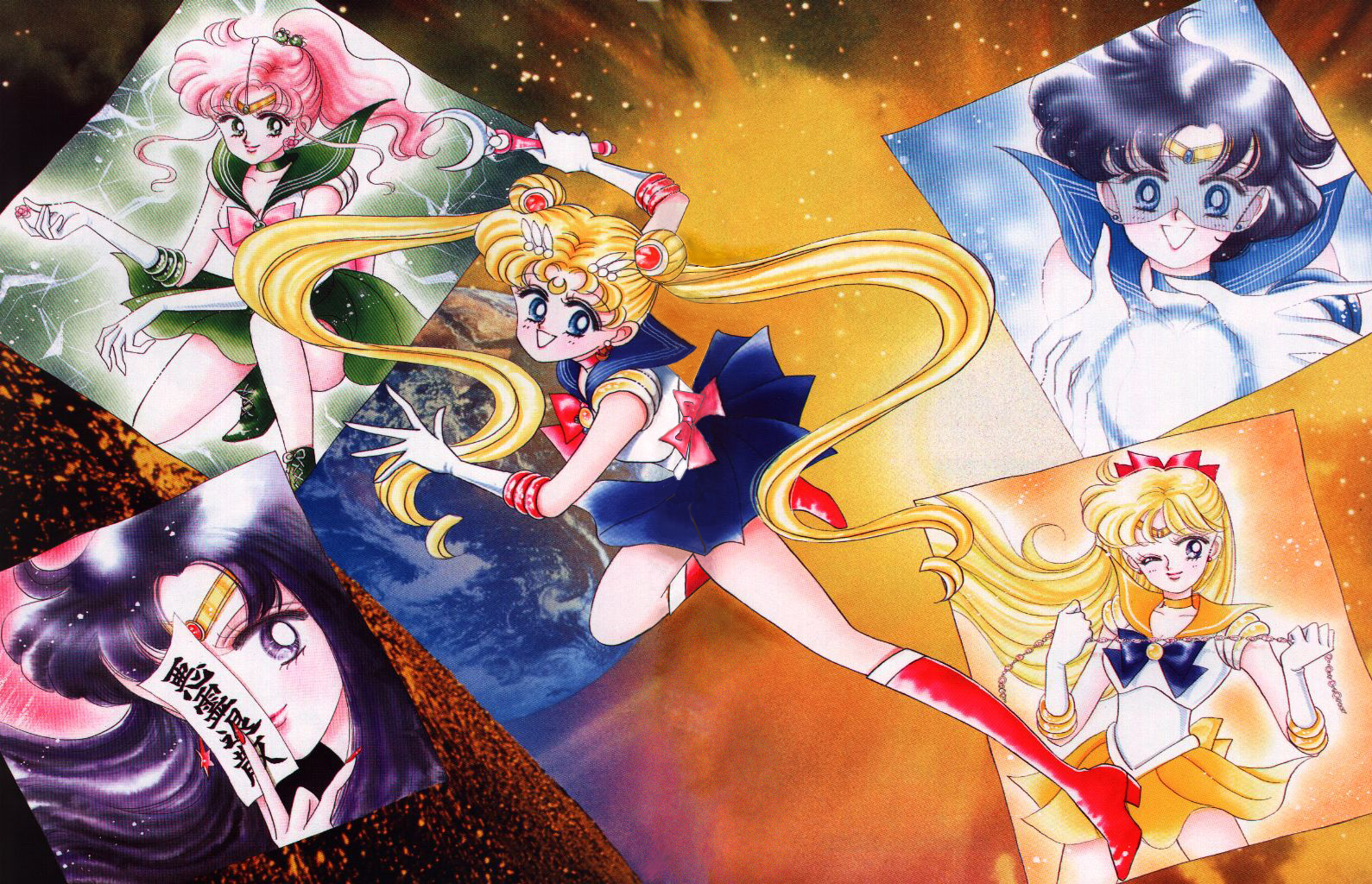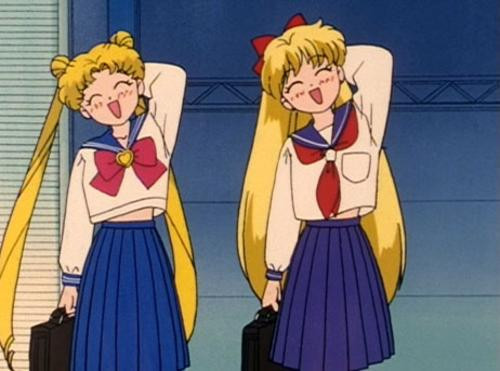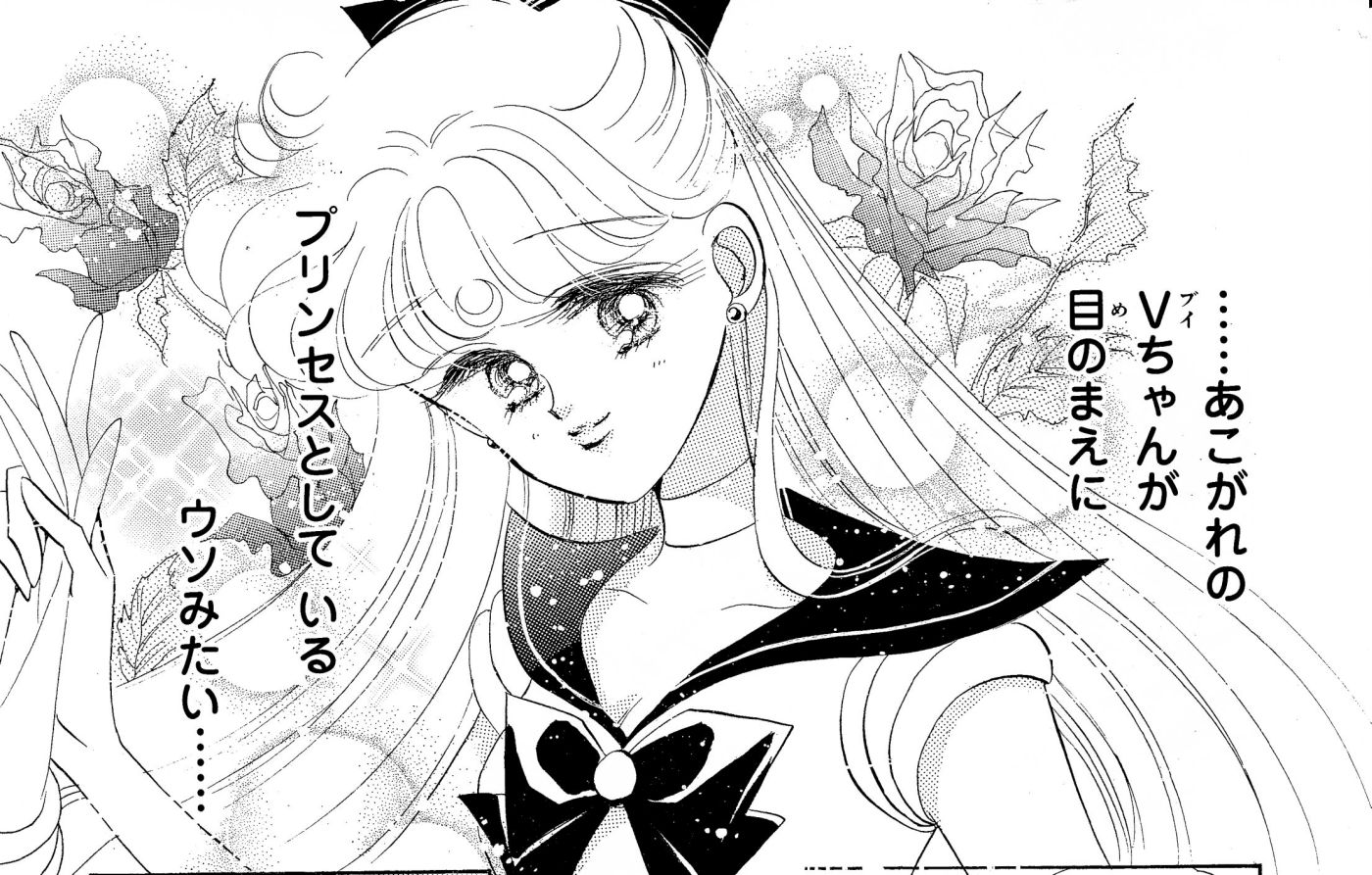
One interesting issue regarding the character of Rei that is often pointed out among fans as an “inconsistency” is the slight oddity that a Shinto priestess would be attending a Christian junior high school. As we can see in multiple issues in the manga and continuously throughout the anime, Rei is a rather gifted young woman with mystical powers allowing her to sense evil, have premonitions, and otherwise engage in other experiences we’d typically describe as a “sixth sense.” Beyond that, Rei frequently performs fire readings and performs the role of a miko (巫女; shrine priestess)1 in carrying out Shinto rituals at the shrine. Taking all of this together, it may seem a bit strange at first glance that Rei would attend a Christian school. However, taking the situation and status of private schools in Japan, it’s not actually all that surprising. Let’s take a closer look!
Category Archives: Articles
Long-form articles exploring an issue in-depth.
Why Were There Five Sailor Soldiers in the Beginning?
With such a long-running and beloved series like Sailor Moon, it’s easy to overlook some of the more basic details of the series as obvious and just part of “the way things are,” but when you actually stop and take a close look, you can’t help but wonder why that’s how things turned out. The fact that there were originally five members of the Sailor Team, for example, is one of those. Often referred to as the “Inner Senshi,” the original five sailor-suited beauties making up the core team are simply seen as the staple of the series, but when you actually stop and think about it, things don’t quite add up. Though there’s been no direct word from Ms. Takeuchi on this issue, there’s a surprising amount of tradition in Japanese TV, manga, and traditional theater culture as well which supports this five member team, so let’s see if we can make some sense of it!
Would it be Legal for Mamoru and Usagi to Date?
Or, a better (though not as easy-to-read) title would be “What are the Legal Implications for the Relationship Between Mamoru and Usagi in the Anime?” However, I think we’ll need to give up a little bit of clarity in the question here for ease of reading. Please forgive the ambiguity.
This is, however, an interesting and important question when you actually stop and think about the ages of the characters involved. Usagi is, in both the manga and the anime, 14 years old and a second-year junior high school student. Mamoru, on the other hand, ranges between him being 16 at the start of the manga1 to 18 at the start of the anime.2 Though at first glance, this two-year age difference doesn’t seem to matter much or have many implications, it actually has huge implications legally, especially when you consider the difference between a 14 and a 16 year old dating and a 14 year old dating an 18 year old man.
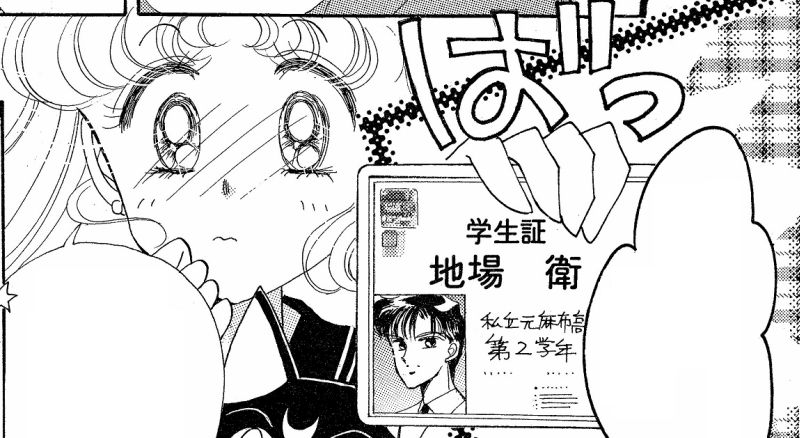
I’d say it’s safe to put the manga aside, then, and to say that there are no real implications there. A two year age difference is pretty minor anyway, and since they’re both minors, it’s no big issue. Now for the anime, there are some issues which come into play due to Mamoru being older than 18. While the age of majority in Japan is 20,3 local and national laws protecting children (and the ones which would also consider any conduct between Usagi and Mamoru between minors) cut off at 18 and the Juvenile Act (which prevents the conviction of minors under the normal laws for criminal acts) has been modified to allow for criminal trials as young as 16.
But that’s not to say that Mamoru and Usagi dating is against the law – in fact, it isn’t. If they maintain a nice, pure, and chaste relationship like we see on screen, then there’s absolutely nothing to worry about. This is the same in most countries, actually, in-so-far that the relationship itself isn’t forbidden, just certain acts carried out therein. The relevant law is Article 176 of the Penal Code,4 which reads:
A person who, through assault or intimidation, forcibly commits an indecent act upon a male or female of not less than thirteen years of age shall be punished by imprisonment with work for not less than 6 months but not more than 10 years.
So we’re okay then! Nothing indecent going on between the two of them, right? Well, yes and no. Episode 22 mucks things up a bit, actually.
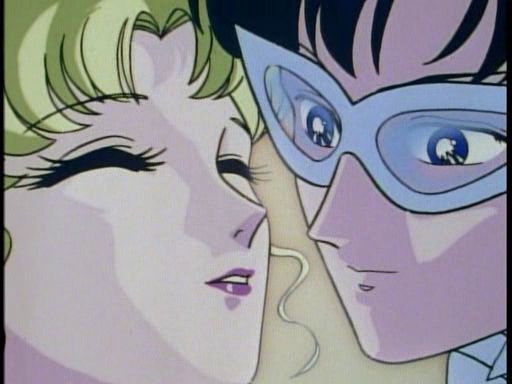
While Sailor Moon and Tuxedo Mask are star-crossed lovers, reunited across millennia, unfortunately for him being 18 years of old and kissing a junior high school student who drank alcohol during the party falls under an “indecent act.” But there’s no assault or intimidation, so we would have to consult Article 178(1) of the Penal Code, which reads:
A person who commits an indecent act upon a male or female by taking advantage of loss of consciousness or inability to resist, or by causing a loss of consciousness or inability to resist, shall be punished in the same manner as prescribed for in Article 176. (emphasis added)
Now I know people are throwing down their pens here and saying that I’m being overly pedantic and that Usagi and Mamoru are deeply in love and that no one in their right mind would call this a crime. And you know, you’re absolutely right! I totally agree with you. The good news is that the Japanese laws actually agree with you (and me!) too.
You see, Articles 176 – 178 are limited to what’s known as a shinkokuzai (親告罪; a crime which is only prosecutable if there is a complaint made), which is covered under Article 180 of the Penal Code:
The crimes prescribed for in Articles 176 through Article 178 and attempts of the above-mentioned crimes shall be prosecuted only upon complaint.
Absent a complaint by Usagi – which, as we established, wouldn’t happen as she was consenting and loves Mamoru – there’s no illegal conduct here. So for once, common sense actually wins in a discussion about the law and human interactions! In short, though their relationship is on shakier ground in the anime than in the manga, their relationship is totally fine as long as the law is concerned.
Why Did Sailor Venus Play the Role of the Moon Princess?
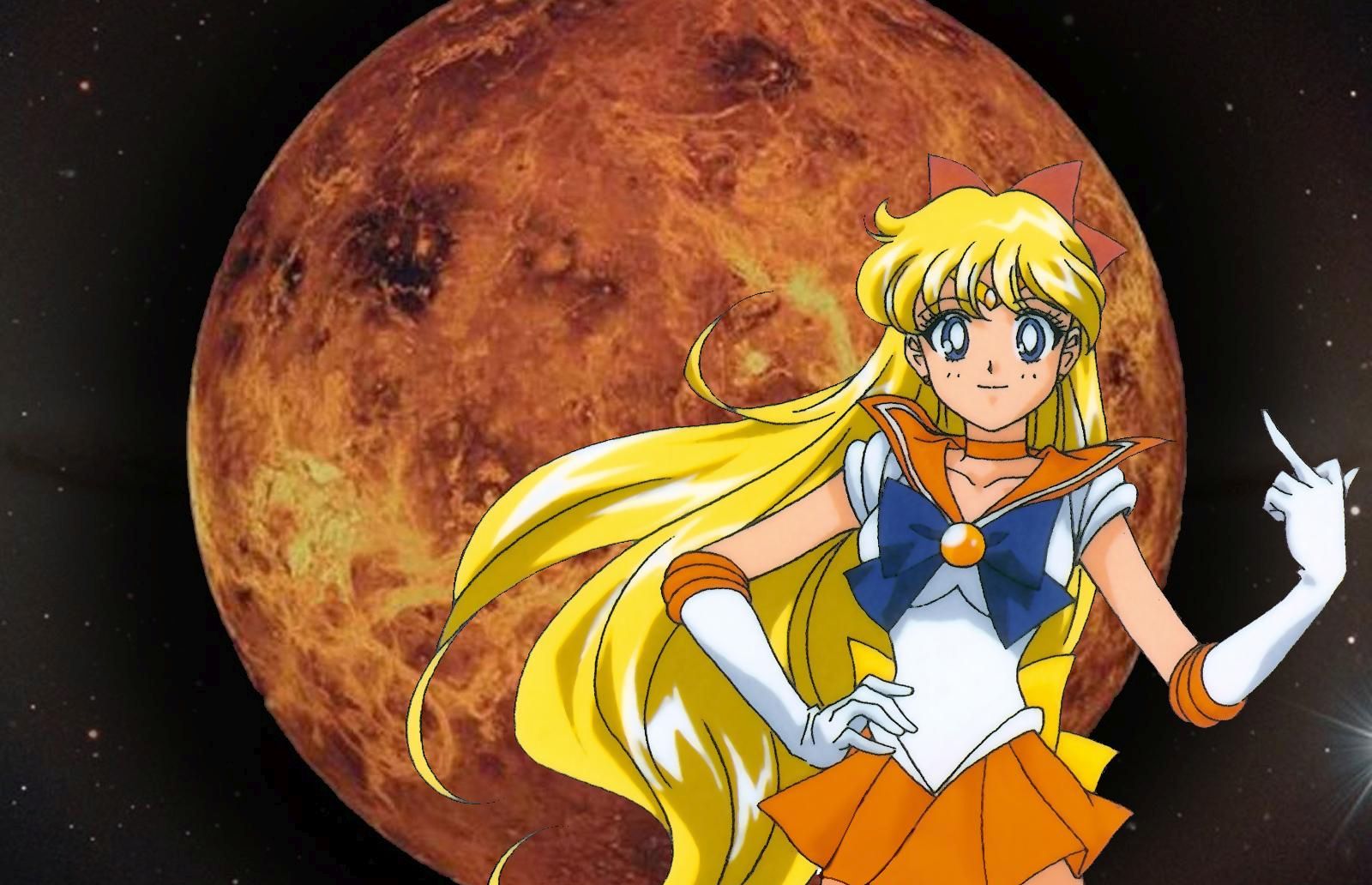
One of the odd peculiarities of the co-existence of the shared universes of Code Name: Sailor V and Pretty Soldier Sailor Moon is the fact that despite Sailor V(enus) being the first Sailor Soldier to make an appearance, she was the last one to join the team. Not only that, but despite having been the self-proclaimed Sailor Venus,1 she further claimed that she was was the true heir to the Moon Kingdom – Princess Serenity. She not only has the crescent on her forehead, but the Crescent Compact2 to prove it. So what gives? Why was she the one chosen to play the role of the princess (and not Ami, Rei, or Makoto?) and, for that matter, why does she even have a crescent compact in the first place if she’s not even from the moon?
To answer this question, we need to go back in time—almost 405 years exactly3 to the late fall/early winter of 1610, and to the observations of the planet Venus made by Galileo Galilei. Though the existence of Venus had been known to civilizations across the globe since time immemorial, one of Galileo’s greatest contributions to the budding field of astronomy gained through his observation of Venus was in his finding proof that the old geocentric model (in which the Sun, stars, and other celestial bodies revolve around the Earth)4 was provably wrong and that the heliocentric model (in which the Earth and other celestial bodies revolve around the Sun)5 must be correct.
And how did Galileo come to this conclusion? Through his observation that Venus has a crescent phase, much like the moon. Or, in Galileo’s own words (in Latin):6
Cynthiae figuras aemulatur mater amorum
And in English:
The mother of love [Venus] copies the forms of Cynthia [the Moon]
Indeed, as Galileo saw it, the significance of Venus in his observations was that it was displaying the same phenomenon we observe on a monthly basis when looking up at the moon. Put into other words, Venus was imitating the moon – not unlike how Sailor Venus pretends to be Princess Serenity, the heir-apparent to the Moon Kingdom. This would also explain being given the crescent compact in the Sailor V manga and her using it as a weapon, since the crescent shape of Venus was one of its important features. Furthermore, it’s unlikely that any of this would have been lost on Ms. Takeuchi. Not only was she clearly thorough with her research in the first place, but she herself is a fan of astronomy and was a member of the astronomy club in high school.7
As for why Sailor Venus was the last to join the team despite the first to make an appearance, there could of course be many answers for this, but part of the reasoning behind that may also lie in her namesake planet: Venus is known both as the Evening Star and as the Morning Star, due to it appearing early in the evening shortly after the sun sets and preceding the sunrise in the early morning. This tracks nicely with her appearance in the Sailor Moon anime and manga, as she both preceded (Sailor) Moon and was the last to make her appearance.
It’s unclear how much of the story Ms. Takeuchi already had planned out ahead of time before the one-shot release of Code Name: Sailor V in RunRun and when, a little over half a year later, Pretty Soldier Sailor Moon was first serialized in Nakayoshi, but considering all the work she went into putting together all the other mysteries of the series, there’s definitely a lot there to support a variety of theroies!
Why Isn’t Minako’s Name Associated With Venus?
One of the first things anyone with even a passing interest in learning Japanese will notice is that the names of all of the (inner) Sailor Soldiers is that their names follow a pretty noticeable pattern. Even if you haven’t studied Japanese, you’ve likely read about their names and explanations thereof in countless numbers of profiles online. For the sake of a quick summary, the Japanese no (の) serves as a possessive and can mean something similar to “of” or signify ownership, much like ” ‘s ” in English. In this way, the last name of each of the characters makes a nice wordplay which signifies not only elemental affinity, but the celestial object they’re tied to. Though the English names for the planets are gaining traction in recent years, traditionally the other inner planets (excluding Earth) and Jupiter have been referred to by elements, which ties back into the elemental affinities of the inner soldiers.
Here you can see the Japanese names of the planets: Mercury (水星; suisei – water planet), Venus (金星; kinsei – metal planet), Earth (地球; chikyuu – earth globe), the Moon (月; tsuki – Moon), Mars (火星; kasei – fire planet), and Jupiter (木星; mokusei – wood planet).
The same characters are found in the name of the Sailor Soldiers: 月野うさぎ (Tsukino, Usagi – Usagi/Rabbit of the Moon), 地場衛 (Chiba, Mamoru – Mamoru/Protector of the Earth), 水野亜美 (Mizuno, Ami – Ami of the Water), 火野レイ (Hino, Rei – Rei of the Fire), 木野まこと (Kino, Makoto – Makoto of Wood), and 愛野美奈子 (Aino, Minako – Minako of… Love). As you can see, Minako breaks out of this system in a pretty dramatic way and leaves us with the question of just why is it that Ms. Takeuchi decided to not follow the pattern with her in the first place.
The easiest answer, of course, is simply that Minako came first, as we talked about before in her debut in Sailor V, approximately half a year prior to her appearance in the Sailor Moon manga. Minako is the self-proclaimed Sailor Soldier of love and beauty, so it only makes sense that she has a name that matches, right? Obviously her character being created prior to the rest and before Ms. Takeuchi herself had the naming patter down clearly plays a roll in this, but there are several other reasons which likely played into the decision.
For one, in order to name Minako after the planet Venus (and to conform with the naming system of the rest of the Sailor Soldiers), she would have had to name her 金野美奈子 (Kin’no, Minako). This name unfortunately doesn’t exactly roll off the tongue in Japanese, and obviously is a little too close to comfort with Makoto’s name. The other reason is that, through a clever play on kanji readings, it turns out that Ms. Takeuchi already did manage to sneak Venus into her name, all without having to bother with using her last name to do it.
As you may know (and probably noticed above), Japanese kanji can generally be read at least two different ways, very often more. These readings are referred to as their on and kun readings.1 Taking Ami’s name, for example, her last name Mizuno (水野) contains the same character as Suisei (水星). The same applies to Hino (火野) and Kasei (火星), and Kino (木野) and Mokusei (木星). Well, if one were to take alternative readings for Minako‘s (美奈子) first name, you can actually pronounce her name as Binasu2 – the older Japanese romanization of the English name “Venus.”
So while it might not be apparent on the surface, it turns out that Ms. Takeuchi did manage to slip the the planetary reference into Minako’s name! It’s amazing how far she really thought these things through…
Was Makoto a Member of a Gang?
Out of all of the Inner Sailor Soldiers, Makoto is definitely the one who has changed the most from her original inception and her final incarnation in the manga. Ami and Rei of course also differed from the original plans written up by Ms. Takeuchi (to say nothing of the differences between manga and anime Rei) – though the differences weren’t quite as dramatic as Makoto – while Minako stayed largely the same, thanks greatly in part to the fact that she starred in her own prequel manga running parallel to the Sailor Moon universe.
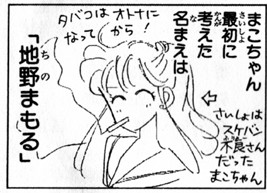
As we’ve discussed previously, the Makoto Kino that we know today was originally to be known as Mamoru Chino, a cigarette-smoking, rough-and-tumble junior high school girl. Naoko’s notes here read (clockwise, starting from the top):
- Wait until you’re an adult before you start smoking!
- This is the first name I thought up for Mako-chan
- In the beginning, she was a juvenile delinquent sukeban (to be discussed below)
- “Chino, Mamoru”
So we can see here that Makoto was originally planned to be something of a juvenile delinquent though, in Ms. Takeuchi’s own words, apparently she had been reformed somewhat. Though, the question is: did Makoto really change all that much from Naoko’s original plan?
When we first meet Makoto in the manga,1 she’s introduced as the new transfer student to class 2-6 who wears a different school uniform due to “the sizes not fitting,” and according to Umino, was kicked out of her previous school for fighting.2 One of the first things that stands out is not so much that she’s wearing a different school uniform per se, but the style and how she’s wearing it. The long skirt Makoto wears is reminiscent of the sukeban fashion of the time, the mark of a female juvenile delinquent which was popular throughout the 1970s and 1980s. The most popular example of this at the time is probably from the manga Delinquent Girl Detective (スケバン刑事),3 a manga series which has been adapted into an OVA, live-action drama, and live-action movies. The word sukeban itself is an abbreviation of sukebanchou (女番長), which stands for “female gang leader.”
In addition to the other variations/accessories to the style,4 some of the main hallmarks of the sukeban was the long skirt, the rolled-up sleeves, and the lack of the bow or ribbon that typically accompanied the sailor schoolgirl uniform. All of these, as you may have noticed, are present in Makoto’s character design.
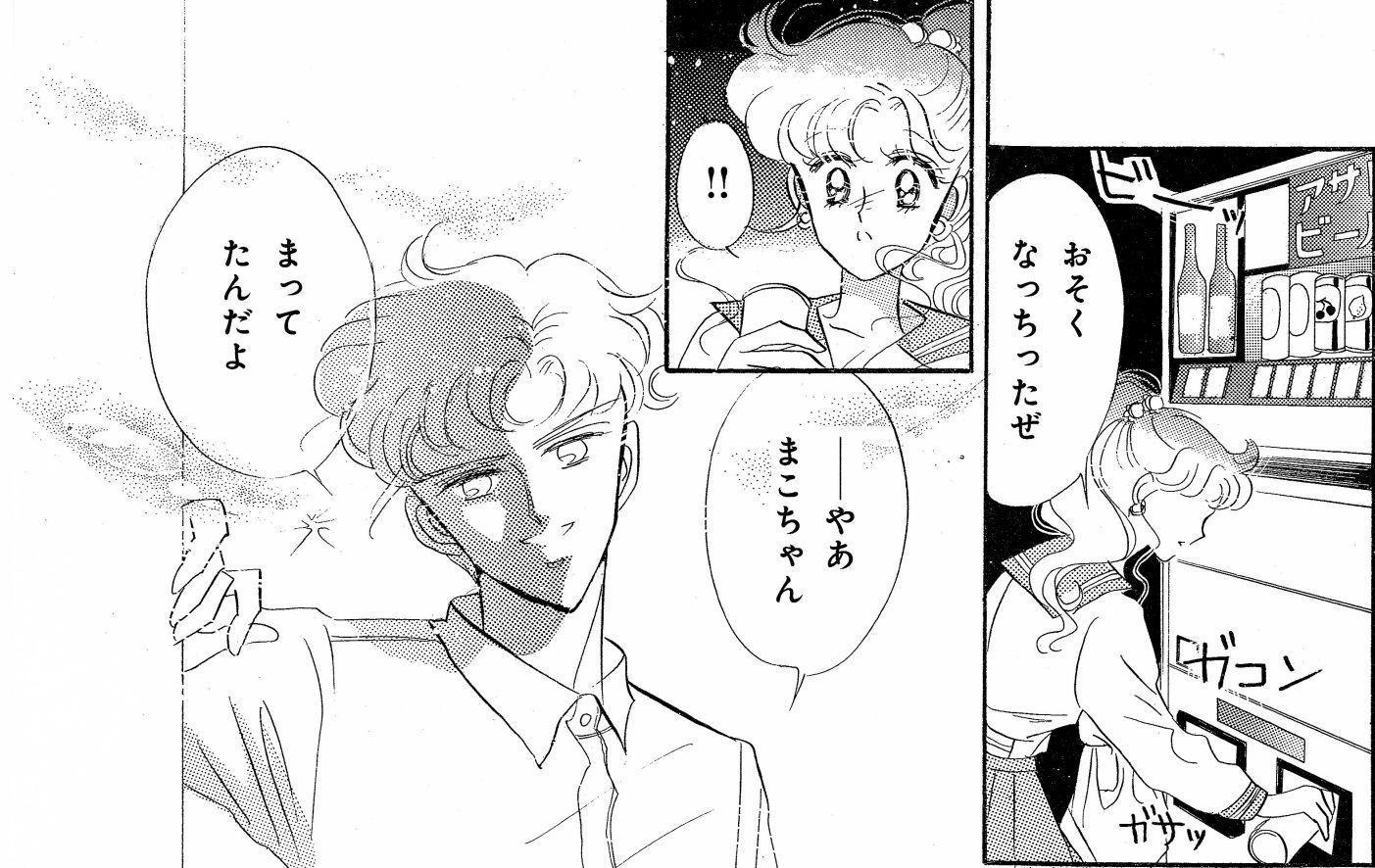
Last, but not least, for the evidence toward Makoto still retaining the wild streak Ms. Takeuchi had originally planned for her, is the scene in the manga where Motoki, possessed by a youma, tries to seduce Makoto.5 In the scene, we can see Makoto, alone, going to a vending machine late at night.
What’s noteworthy about this scene, however, is the sign at the top of the machine which reads “Asa__ Beer.”6 At the time (and even today), it wasn’t uncommon to find vending machines selling alcohol that anyone could purchase from without supervision or needing to prove your age,7 which it looks like Makoto is doing in this scene.
While Makoto may not be – as far as the storyline canon is concerned – a member of a gang, it’s pretty clear that Ms. Takeuchi’s original intentions for the character are that she has some strong anti-social tendencies and, even if not directly involved in gang-like behavior, definitely bears a strong resemblance to the anti-establishment movements at the time. It’s also pretty evident that, though I’m sure she was tamed down a little bit and became even more so as the series progressed, Ms. Takeuchi intended for her to still be something of a troubled and openly defiant young girl. I’d love to see more of her notes on this someday, but for now we have to just make do with what you can see in the manga!
How Were the Sailor Soldiers Reborn After the Fight With Queen Beryl?
Talking about the Sailor Moon timeline is a bit of a grey area right out of the gate, simply because the anime and the manga obviously differ, and pretty greatly at that. Obviously this is a fictional universe so we can’t hold out a lot of hope for things to be 100% accurate, nor should it be. If we were concerned with absolute accuracy, I’m pretty sure we wouldn’t be talking about junior high school girls fighting the forces of evil to begin with! But to the extent that we can recreate the timeline and make some sense of it, I think it’s a worthwhile endeavor.
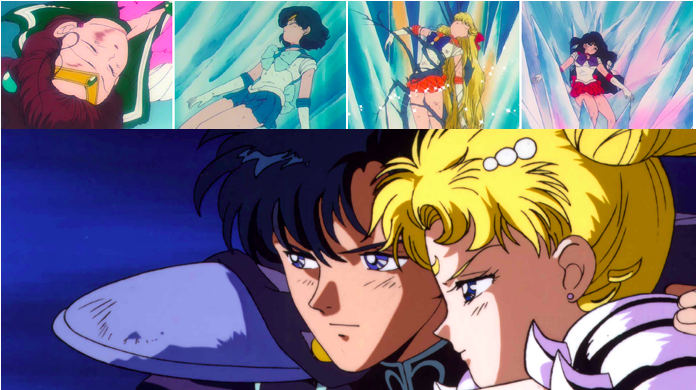
We talked in-depth before regarding how long the fight against the Dark Kingdom and Queen Beryl would have taken and ultimately came up with thirty-three days, with a lot of caveats of course. Though I haven’t checked the anime – and with 46 episodes which need to be watched, I’m afraid it would take an incredibly long time to do a thorough analysis – but my gut instinct is that there the battle against the forces of the Dark Kingdom took a little under a year, though seems to be fair to assume that the series followed along close to real time.1 These timeline issues actually are pretty helpful in answering the above question, regarding how the Sailor Soldiers came back to life after their untimely demise in their battle against the D-Girls in the anime. That’s right! Today, we’ll be talking about the anime timeline, though we’ll turn back and tie this into the manga where we can.