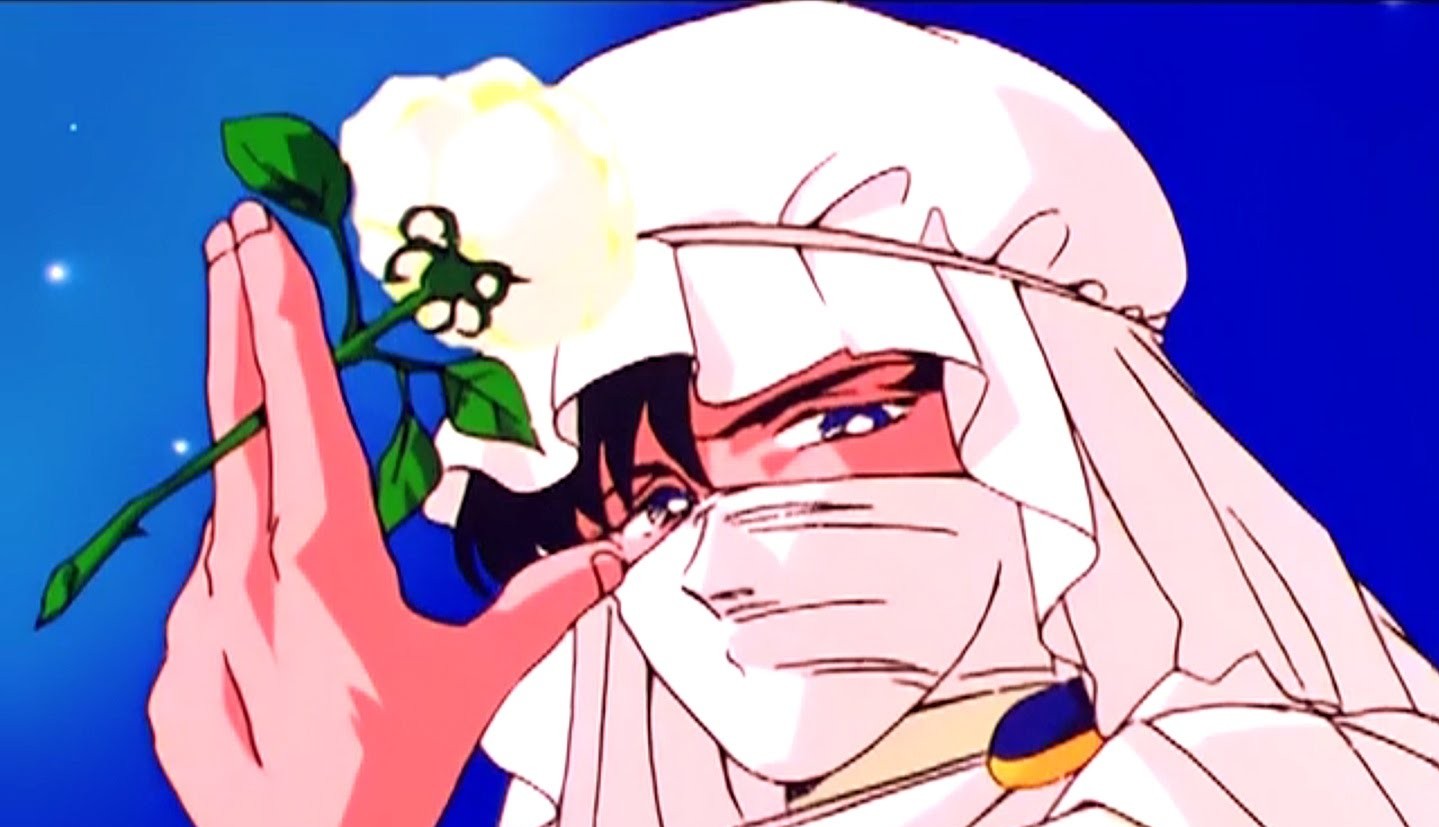
While the idea of a masked hero coming to save the day isn’t exactly novel or unique, nor was Sailor Moon the first media in which one appeared, one thing that always did seem special about Tuxedo Mask was that he dressed up in such a fancy outfit while he did it. In some odd way, it seems oddly fitting for a high school/college student to dress in a suit and cape while throwing roses to save sailor-suited soldiers of justice. What a lot of people don’t know, however, is that there’s actually quite a bit of history to the creation of the character of Tuxedo Mask, from a popular Japanese character based on the Japanese adaptation of a French story, and has connections going back nearly one hundred years, and even has overlaps with the Sherlock Holme franchise. So who was the source of inspiration for Tuxedo Mask, and where did Ms. Takeuchi pick up the basis for his design?
Category Archives: Articles
Long-form articles exploring an issue in-depth.
How Different Was the Pacing of the Sailor Moon Anime and Manga?
Taking into consideration that the manga was serialized in Nakayoshi magazine at a rate of one act per month1 while the anime needed to consistently churn out episodes on a weekly basis, it’s plain to see that there would be definite pacing differences between the two. What’s interesting, though, is that when you take the time to actually look at the data, the story flow of the Sailor Moon anime and manga are actually more similar than you would assume. A word of warning: we’re going to be looking at a lot of numbers today!
First off, we need to establish our points of comparison. We know that the manga ran for 52 acts and the anime for 200 episodes. For the sake of a fair comparison, though, I believe we need to remove the Cardian Arc (as much as I may like it) from the Sailor Moon R anime and also the beginning of Sailor Stars since it was a continuation of the Nehelenia story line. We also will not be counting the side stories (picture diaries, etc.) in the manga. Once you do that, here is how the numbers break down:
| Story Arc | Episodes | Acts | Eps/Acts |
|---|---|---|---|
| Dark Kingdom | 46 | 13 | 3.5 |
| Black Moon | 30 | 10 | 3.0 |
| Death Busters | 38 | 10 | 3.8 |
| Dead Moon | 39 | 9 | 4.3 |
| Sailor Stars | 26 | 10 | 2.6 |
| Total | 179 | 52 | 3.4 |
As we can see, though it differed on a season-by-season basis, on average the anime had to make 3.4 episodes per act in the original manga – and that makes sense, considering they needed to track how the manga developed on a roughly monthly basis. But what does this mean for the actual story progression, and how did they differ due to this need to add episodes? Interestingly enough, it didn’t have as much on an impact as I would have thought, though the anime did choose to pad out the story in interesting ways (and even shorten certain story arcs, it seems).
In order to answer this question, I think the most clear-cut way is to look at important story events and compare how early/late they occurred and how much attention certain elements were given as a part of the total story arc. Let’s get started!
Dark Kingdom
As you can see here, this shows how much the series had progressed by the time the character was introduced (in percentages). For example, Ami appeared in Act 2 of the manga and episode 8 of the anime. This works out to 15% and 17% of the way through the plot, respectively, and is actually pretty close. Rei (at act 3 and episode 10, 23% and 22% respectively) is also pretty close in the manga and anime. Makoto and Minako, however, are a different story. It seems that the anime staff wanted to take a break from introducing new characters for a bit and held back for quite a while on Makoto’s introduction, probably until they were ready to bring in the Rainbow Crystal story line.
Speaking of which, you can also see that there was a great amount of difference in how the time between the Four Kings and the end-game (or with Queen Beryl as the main villain) was split up in the manga and the anime.2 First, the manga:
Interestingly enough, an equal (or near-equal) amount of attention was given to each of the main villains in the manga, including the end with the drawn-out battle against Queen Beryl/Metalia. How did things look in the anime, then?
And… wow. Jadeite and Kunzite have around the same respective shares, but I was surprised to see that Nephrite and Zoisite actually were around for nearly as long as the rest. Of course, the padding added to them greatly impacted the post-Kunzite part of the story, which was reduced to a paltry two episodes.
Overall, I think what I learned by taking a look at the actual numbers of the two tellings of the Dark Kingdom arc was that they’re surprisingly more similar than I had thought, when you take into account the volume differences. You could probably make other observations depending on how fine-toothed of a comb you want to use looking at the data (amount of times the Sailor Soldiers fight, number of days passing, side-character interactions, etc.), but I think this makes an informative visualization.
Unfortunately, this article has gone on a bit long, so we’ll have to save the analyses for the rest of the story arcs until the next part. What other interesting differences are waiting to be discussed, I wonder…?
Why Does Fiore Look So Much Like Ail and An?
The first time anyone sees the Sailor Moon R movie, I’m pretty sure one of the things to pop into their head is that, you know, the villain of the movie looks an awful lot like those villains, Ail and An, who appeared in the Cardian Arc of the anime. Surprisingly, though, despite the fact that it’s pretty obvious and seems like a consistency issue you’d like to address, absolutely none of the Sailor Soldiers (or even Fiore himself) address this issue. As silly as it sounds, this has been nagging at me for years and I finally decided to take a look into it.
One of the things that makes it much more difficult to use the Sailor Moon anime as a source when trying to pin down its various mysteries is the fact that you can never quite be sure what parts of the story are meant to be canon (i.e., fit into the larger context of the story and “actually happened”) and what events are meant to be side stories. Making matters worse, the anime wasn’t even too concerned about internal consistency for events that were clearly canon, like Sailor Pluto’s death at the end of Sailor Moon S and her casual reappearance in the SuperS movie and in the Stars anime, as if nothing had happened.
Typically, though, I think it’s safe to say that the Sailor Moon movies are non-canon, especially since the Sailor Team doesn’t seem too particularly concerned with other enemies at the time (the Black Moon Family is never mentioned in the R movie, etc.) and at the beginning of each season and the arrival of the next threat, it seems pretty clear that they haven’t been fighting any other enemies in the mean-time. That said, the Cardian Arc itself could be considered non-canon, which leaves us with a possible double-non-canon interesting plot issue.
Researching this issue lead me to a source I’ve gone to before to answer series canon questions; the December 1993 edition of Animage magazine1 which featured an interview on page 28 with the Sailor Moon R series (and movie) director, Kunihiro Ikuhara2 as a part of the promotion machine for the then-upcoming Pretty Soldier Sailor Moon R: The Movie.3 Much to my surprise, he actually addresses this question head on:
「敵キャラクターを見ていただければおわかりのとおり、今度の話は”エイルとアン編”のリニューアルなんです。もちろん、描く角度はぜんぜん違ってますけどね。」
“As you can tell by looking at the enemy, this story is a renewal of the Ail and An arc. Of course, the angle we’re telling [the story from] is completely different.”
“Renewal,” when used like this in Japanese, would be akin to a remake in the West, with the implication that something has been updated and redone better than before, as with a shop being renewed, or the re-release shinsouban manga which was referred to as the “Renewal Edition.”4
So after all these years of wondering if they’re from the same planet, if they were siblings, or if maybe all aliens outside of the Sol system looked that way (though this was disproved in Stars), it turns out the answer is really quite simple: the movie is taking the basic premise of the Cardian Arc and is a retelling, using story elements from the Black Moon Family (primarily ChibiUsa’s existence) to flesh out the story.
I’m happy to have this mystery finally put to rest, though to be honest a part of me does wish that there was a bit more to the story. I’ve always been a fan of the Cardian Arc and the characters appearing therein, so it would have been nice to see the story expanded upon rather than re-written. But it is good to know that Mr. Ikuhara did address the issue!
Why Is Makoto Always Chasing After Men?
It’s always been interesting to me just how far Ms. Takeuchi went to take various related sources and pool them all together when creating the designs and personalities for each of the Sailor Soldiers. I feel that this is much more obvious in the original, so-called “inner” soldiers (even if that name is a bit of a misnomer, considering Jupiter is most certainly an “outer” planet),1 though planetary and mythological inspiration can still be seen here and there in the colors and designs of the outer soldiers. For example, Usagi is smaller than the rest of the cast because the moon is itself small while, on the other end of the spectrum, Makoto is the tallest of the group. Taking a look at mythology, we have the obvious Selene and Endymion connection and of course, the Minako / Venus / Aphrodite “goddess of love” inspiration. But what about Makoto? What role does her unrequited love for her ex-crush (and subsequent chasing of other men reminding her thereof!) does her role as the soldier of Jupiter play?
Did Moonlight Knight Make a Mistake in French?
Moonlight Knight is a bit of an oddball character in the Sailor Moon anime, as he’s one of the few “hero” characters that exist only in the anime with no manga connections at all. The whole Cardian Arc1 was completely made up for the anime only, supposedly to give Ms. Takeuchi a chance to prepare her next story arc while the anime rushed ahead of her, though I’ve always suspected that the true purpose of this was to give them a sort of teaser for the upcoming Sailor Moon R movie. That, however, is a story for another time. What we’re here to look at is: what’s with Moonlight Knight’s use of French?
Possibly even more than Tuxedo Mask himself, Moonlight Knight was fond of long, dramatic speeches.2 More interesting to me, though, is what he said when he departed. Despite his strong Arabian design, Moonlight Knight always leaves the Sailor Team with a fancy “adieu.” What’s noteworthy about this is that it appears to have been a mistake by the anime production staff, directly translating his さようなら (sayounara; good bye) into something more fancy-sounding without looking into the cultural context. The issue here is that adieu implies that you don’t believe that you will see the other party again (at least not soon), and that you are saying good bye with a sense of finality. What he should have said was au revoir, which is used when you do believe that you will be crossing paths in the near future.3
While I would like to say that there was some sort of deeper meaning to this word choice and over-analyze the issue, I’m afraid that this is pretty much clearly a case of not having done the appropriate cultural research. If I were to read into the issue, however, I would say that you could make the assertion that this was Moonlight Knight’s way of expressing that he hoped he and Mamoru would soon re-join (i.e., Mamoru’s physical / human form and his sense of duty to protect the Sailor Soldiers) and was bidding them farewell. Put another way, by implying he would see them again would suggest that Moonlight Knight did not intend to return to Mamoru and resume his activities in the form of Tuxedo Mask.
Of course, this is probably looking way too into it, but it’s at least an interesting tidbit, if nothing else! Since Mamoru is a university student in the anime, and many university students are required to learn a second foreign language (other than English), it’s entirely plausible that he did study some French. You’re pretty clever, Mamoru!
How Did Sailor Moon’s Disguise Pen Work?
Among all of the special items that Luna gives Usagi and all of the other Sailor Soldiers, I’ve always felt that the Disguise Pen was one of the most interesting, and yet also the most under represented. How is it that you could have a pen that could turn you into whatever you wanted to look like (and typically allow you to look like a grown adult despite being a fourteen year old girl…) and yet so rarely ever use it? In fact, out of its 11 appearances in the anime and six appearances in the manga,1 all but two of them in both the anime and manga occurred in the the Dark Kingdom arc.
What particularly interests me, though, is how more often than not Usagi manages to use the pen wrong and all the while still gets a semi-satisfactory result. What do I mean by that? Well, let’s take a look!
How Did the Moon Frisbee Become the Moon Boomerang?
Few attacks in the history of the Sailor Moon series have undergone as many alterations as the sailor-suited soldier’s debut attack in both the manga and the anime. While it’s up for debate whether or not her crying, which unleashes ultrasonic sound waves that distract the youma Morga in the midst of her assault,1 is a special attack in its own right, in the tradition of most anime and live-action shows in the sentai fighting-force line, I think it’s fair to say that anything without an explicit name is just a part of them being super soldiers of justice. Otherwise, you will need to start coming up with names for their ability to jump to high places, a name for Sailor Jupiter’s punching, and more. That said, Sailor Moon’s tiara is the first named attack, but its name has gone through several major changes. What gives?